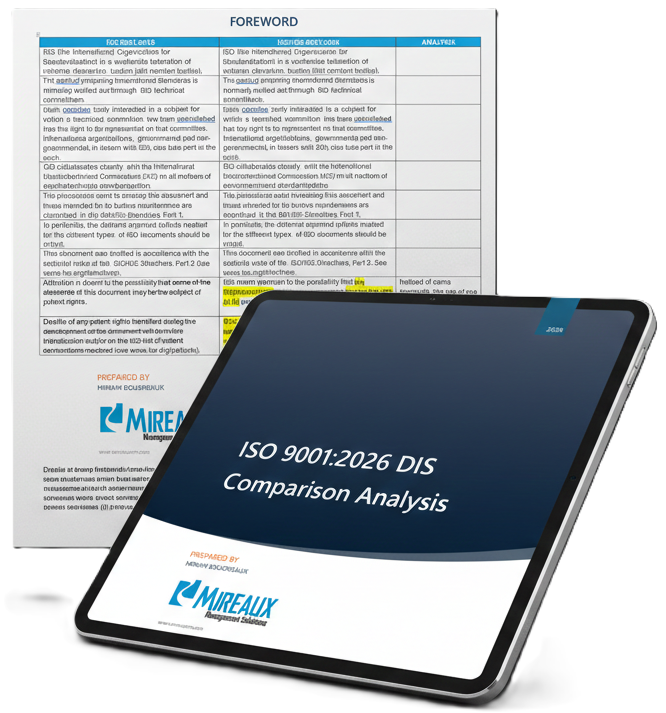
The Draft International Standard (DIS) of ISO 9001:2026
The Draft International Standard (DIS) of ISO 9001:2026 marks the sixth edition of the world’s most widely adopted Quality Management System standard.
At first glance, the Foreword appears nearly identical to ISO 9001:2015. However, several subtle yet important changes signal shifts in governance clarity, patent responsibility, and how ISO frames the revision.
In this article, we break down the ISO 9001:2026 DIS Foreword section by section and explain what these differences mean for organizations preparing for transition.
ISO’s Role and How the Standard Is Developed
Both ISO 9001:2015 and ISO 9001:2026 DIS begin by explaining that ISO is a global federation of national standards bodies.
This reinforces an important principle:
- ISO 9001 is not written by one country.
- It is not industry-specific.
- It is developed through international consensus.
Because ISO standards must apply across industries, cultures, and regulatory environments, their language is intentionally generic and principle-based.
The 2026 draft maintains this structure and positioning.
Responsibility for the Document – A Subtle Framing Shift
One of the first noticeable wording adjustments concerns responsibility for developing the standard.
The ISO 9001:2026 draft states that the document was prepared by Technical Committee ISO/TC 176, Subcommittee 2.
Unlike prior editions, the language appears less focused on exclusive responsibility and more aligned with collaborative development processes.
While technically minor, this reflects modern standard development practices that emphasize broader stakeholder involvement.
The Voluntary Nature of ISO 9001
The Foreword again clarifies that ISO standards are voluntary.
This remains unchanged in substance, but it serves as a reminder:
ISO 9001 is only mandatory when required by:
- Customers
- Regulators
- Contracts
- Industry schemes
For most organizations, certification is a strategic business decision—not a legal obligation.
Patent Rights Language – The Most Meaningful Update
One of the more significant shifts in the ISO 9001:2026 DIS Foreword relates to patent rights.
In ISO 9001:2015, ISO indicated that any known patent rights would be identified within the document.
In the 2026 draft, ISO clarifies that:
- It has not received notice of any patents required to implement the standard.
- Users should consult the ISO patent database for updated information.
What This Means for Organizations
This adjustment reinforces two important principles:
- ISO does not guarantee complete patent disclosure.
- Implementers are responsible for staying informed.
For most companies, this will not change implementation practices. However, it strengthens legal clarity and shifts responsibility more explicitly to users.
Sixth Edition – But No Justification in the Foreword
The ISO 9001:2026 DIS clearly states that this is the sixth edition and that it replaces ISO 9001:2015.
However, the Foreword does not explain the reasoning behind the revision.
This signals that:
- The justification for changes lies elsewhere in the document.
- The real substance of the update appears in later clauses.
- The Foreword remains procedural rather than technical.
What the Foreword Changes Mean for Your Organization
From an implementation perspective, nothing in the Foreword changes how you apply ISO 9001 requirements.
However, it does:
- Clarify governance structure
- Refine responsibility framing
- Strengthen patent-related legal positioning
- Confirm the sixth edition transition
These subtle adjustments reflect ISO’s evolving approach to transparency and accountability.
What’s Next in the ISO 9001:2026 Review
In upcoming analyses, we will examine:
- The Introduction
- Scope
- Normative References
- Clause 4 and beyond
These sections contain the substantive changes organizations must prepare for.
Stay informed and begin planning early—well before the final standard is officially published.