
Get accurate, objective, and professional ISO audits that not only prepare your organization for certification and long-term compliance, but that also becomes an extention of your team.

We support these standards and more
We can also support other ISO-based standards, Ask Us.
We can also support other ISO-based standards, Ask Us.
Our audits are clear, fair, and focused on helping you get better — not stressed
We provide a clear assessment of your system’s conformity—no guesswork, no surprises.
Our auditors have real-world industry experience and strong certification knowledge.
Receive legitimate findings, meaningful observations, and practical recommendations.
Web QMS users receive Audit Agendas, Reports & Findings directly in their Audits App.
Our team works side-by-side with your team to support, complement, or augment your resources and your management system goals

Complete internal audits performed by certified auditors, ensuring compliance with ISO requirements, your own internal processes and procedures.

A complete or partial audit to evaluate your suppliers against ISO requirements or your own internal criteria, to ensure quality, reliability, and risk mitigation.

A focused audit that identifies the gaps between your management system and the requirements of the selected ISO standard. It also provides recommendations for closing the gaps and an overall score, so you can truly see how your management system ranks.
We don’t just point out gaps — we help you understand them.
Outsourcing internal audits eliminates training needs and reduces the burden on internal staff.
Our auditors understand a wide range of industries, processes, and regulatory requirements.
For multi-site organizations, we ensure uniformity and system-wide alignment.
We help you stay audit-ready and maintain compliance throughout the year.

Curious if your subsidiaries can share one ISO certification? Wondering how to handle excessive audit days? In this video you’ll get answers to some of the most pressing questions we hear from our clients:
Stay compliant, stay prepared, and stay ahead of your ISO Certification or ISOSurveillance Audit. Let our experienced auditors conduct your next ISO Audit.
Planning for the audit is essential in order to ensure the audit achieves the goals and objectives desired. Poor planning may turn the audit into wasted time and effort. We can assist your organization plan for the audit, by helping you determine the following:
In general, we use the following nomenclature for reporting findings:
These are strengths and positive attributes that help an organization comply with the standard over and above what may be considered normal or what is typically seen. These type of findings do not require a response.
Opinions made by the Auditor, about activities that can be done more effectively based on experience and best practices. Since the requirements of the standard are being met, albeit not efficiently as seen by the Auditor elsewhere, these type of findings do not require a response.
Views made by the Auditor regarding areas of the process or management system which could become nonconforming should objective evidence become available or the right conditions appear. These could be treated as “near misses” and while some registrars do not require a response to them, Mireaux does encourage its Clients to document these findings and treat them as Preventive Actions in order to proactively resolve or prevent any future problems.
An isolated lapse of either discipline or control during the implementation of a management system element or procedural requirements is considered a minor nonconformity. A minor nonconformity also must not indicate a management system breakdown, and must not raise doubt that products or intended services will meet requirements. Overall the management system requirements are defined, implemented, and effective.
The absence or lack of implementation of one or more required management system elements or clauses constitutes a major nonconformity. These encompass situations which indicate that:
A Gap Analysis is an exhaustive exercise, in which every clause of the ISO or API standard is checked for compliance. While a thorough Gap Analysis includes verification of implementation by interviewing some employees, it is highly focused on reviewing required documentation and records– usually performed from a desk or meeting room. This is why Gap Analyses are also called “Desktop Audits”.
Yes, starting on April 1, 2020, we are able to conduct audits remotely. During remote audits, our Auditors review documentation or records made available electronically and conduct interviews via a Microsoft Teams.
The expectation nowadays is that a full cycle of Internal Audits be conducted “every 12 months”. This may be seen as contrasting the various definitions the standards, may have:
Therefore, even though the language may not be consistent among standards, the expectation is that you will conduct a full cycle of Internal Audits, EVERY 12 MONTHS.
Your Audit Plan, Program, or Schedule should outline when you will conduct the Internal Audits. We recommend pinpointing the month and year, rather than just the year, as this may be seen as too broad and not a good plan.
A full cycle of Internal Audits signifies that you have audited all of the processes in your management system within the 12-month period. Whether you audit one or more process per month, or all processes at once, you have to audit all of the processes that are part of your management system.
A full cycle of Internal Audits also implies that you have conducted the actual audit, issued the findings, and closed out all nonconformities appropriately.
Depending on how your Internal Audit Schedule is setup, we can help you meet this requirement. For efficiency reasons, we usually propose Internal Audits be conducted all at once, meaning your processes are audited in the same timeframe one after another.
There are a few consequences to be expected during your Registrar’s External Audit if you do not conduct your Internal Audit on time according to your Internal Audit schedule, or prior to your Registrar’s External Audit. Below are three possible outcomes based on your Internal Audit schedule’s modus operandi.
If you only conduct one Internal Audit per year, meaning all of your processes are audited at once; missing an internal Audit should be cause for concern. More than likely, you will get a minor Nonconformity during your External Audit, which could possibly be a major nonconformity, especially if you do not even have it on the schedule.
If you conduct several Internal Audits per year, each focusing on a few processes of your overall management system, then missing one Internal Audit may not be as serious. Nevertheless, expect a minor Nonconformity during your External Audit.
If you missed conducting an Internal Audit prior to your initial certification or Stage 2 Audit, then this is serious. Having an Internal Audit prior to your certification audit is a critical requirement and definitely a showstopper:
A Gap Analysis is beneficial when an organization has implemented some elements of the ISO or API standard desired. In this case, a thorough Gap Analysis will provide a clear indication of how close or how far the organization’s management system is in relationship to the ISO or API standard being sought.
However, if the organization does not have any elements of a management system in place, and has not worked much towards meeting any of the requirements of the ISO or API standard desired; then a Gap Analysis is not recommended. In fact, having a Gap Analysis in this situation, is likely to yield a huge gap –as you are lacking just about everything – which may already be evident to your team. If this is your case, save your money and put it towards resources for implementation.
A Gap Analysis may be conducted once or twice while the organization prepares for their certification audit – to get reassurance that their implementation efforts are moving them closer to meeting all requirements of the ISO or API standards being sought.
Having a Gap Analysis at the onset of the certification journey is worthwhile. It should provide clear guidance on the direction to take and provide assurance that you are (or are not) in the right track.
If time and budget allows, a second Gap Analysis could also be helpful before the External Audit or Certification Audit. At this point, the results of the Gap Analysis should provide confirmation that the organization is indeed ready for certification. A type of audit called Pre-Assessment – often conducted by the Registrar or Certification Body themselves – can be equated to this Gap Analysis.
We can help your organization tremendously towards achieving your desired ISO or API goals, by conducting a thorough Gap Analysis that can provide a clear roadmap to certification. Having Mireaux conduct your Gap Analysis also provides a chance for your team to discuss face to face with an expert, areas that may need attention in order to close the gaps.
Additionally upon completion of the Gap Analysis, Mireaux issues a comprehensive Gap Analysis Report that contains a detailed clause-by-clause analysis of the ISO or API standards being sought, providing for each clause:
Mireaux’s Gap Analysis Report also provides an overall percent of compliance, to give the organization a good idea of their “grade” and the road ahead.
There are many reasons that can spark the need to conduct a Supplier/Vendor Audit. Among them are the following:
In essence, reasons for conducting a Supplier/Vendor Audit abound. If your organization practices the ISO principle of “Relationship Management” formerly known as “Mutually beneficial Supplier Relationships”, then being able to audit your Supplier/Vendor should be welcomed as an opportunity for furthering the ties between you and your supplier/vendor.
The ISO management system standards do not require Suppliers/Vendors Audits as part of the evaluation/reevaluation of supplier or vendors. API however, is more prescriptive in its requirements for Suppliers/Vendors’ initial evaluation and selection, as shown on the following API Q2 excerpt:

The requirement above is clear in that an assessment of the supplier needs to be done at their facility (the facility from where the supplier is providing their product or service); however, the assessment can be conducted by your organization, an organization you outsourced to, or a third-party. Whichever method you decide, it should be part of your supply chain program and be documented as part of your management system requirements.
Audits should never be confrontational or offensive. If you have a management system in place that follows the ISO principle of “Relationship Management” formerly known as “Mutually beneficial Supplier Relationships”, then the relationship between you and your supplier/vendor should be one of mutual cooperation and improvement.
In general, Mireaux discourages use of surprise audits or similar scare tactics. We like to send Audit Agendas in advance and make sure that the organization is fully aware of our visit. However, if you truly believe that there are major discrepancies that need to be verified, it is up to your organization to bypass early notification and just show up.
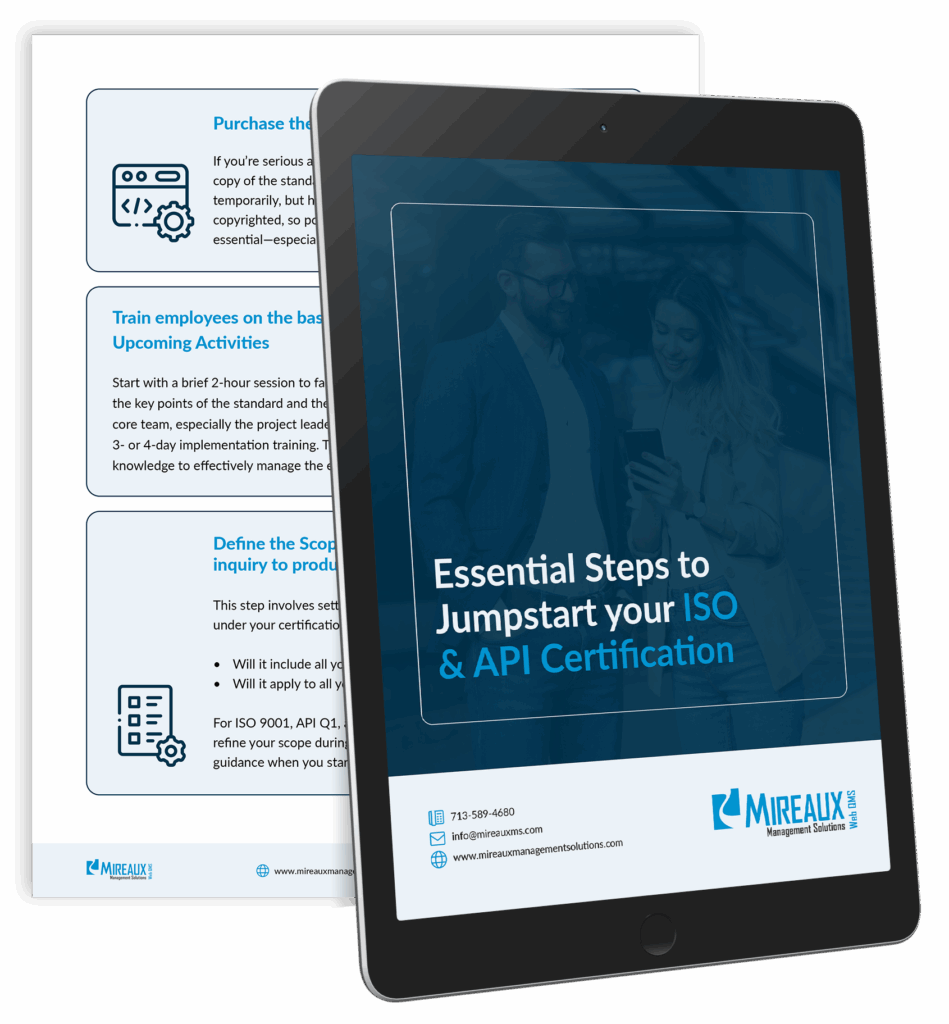
Free Essential Guide
These are the same steps our own Consultants use to successfully guide our clients to achieve ISO/API certification.
DRAFT STANDARD ANALYSIS
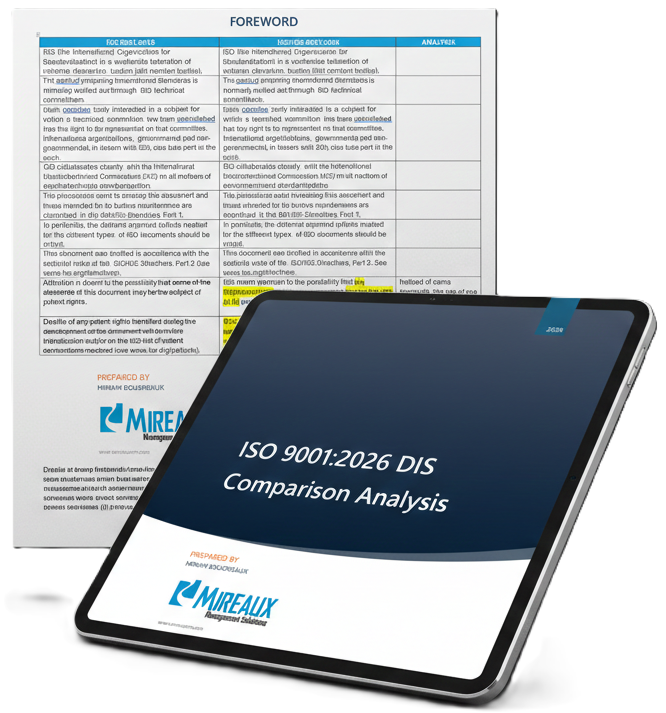
We are actively reviewing the ISO 9001:2026 Draft International Standard and documenting key observations, wording and interpretation changes.
Sign up to receive one section of our analysis per week: