ISO 9001 Transition to the 2026 Edition - Banner
API Q1 Essentials - Category Picture
ISO 9001 Transition to the 2026 Edition
Offered via Instructor-Led (1 day)
Identify what changed, determine what matters, and plan your ISO 9001:2026 transition.
Next Class: 01/12/2027 - Live Stream

Course Menu

About

Update your ISO 9001 system without starting over. This focused course helps experienced ISO 9001 users distinguish substantive 2026 changes from clarified or reorganized requirements, identify gaps, and prioritize practical actions. Drawing on Mireaux’s comparison analysis and implementation experience, turn the revision into a manageable plan for updating processes, controls, records, and audit evidence.

Update your ISO 9001 system without starting over. This focused course helps experienced ISO 9001 users distinguish substantive 2026 changes from clarified or reorganized requirements, identify gaps, and prioritize practical actions. Drawing on Mireaux’s comparison analysis and implementation experience, turn the revision into a manageable plan for updating processes, controls, records, and audit evidence.

Description

Moving to ISO 9001:2026 requires more than updating clause references. Organizations need to determine which changes affect their processes, where existing controls remain suitable, and what additional evidence will demonstrate conformity.

Designed for participants familiar with ISO 9001:2015, this focused transition course uses Mireaux’s comparison analysis and implementation experience to distinguish substantive revisions from clarifications, reorganized text, and relocated requirements. The emphasis is on making sound decisions rather than treating every wording change as a new obligation.

Participants examine how the revised edition affects the QMS foundation, including organizational context, interested parties, scope, process interactions, leadership, customer focus, risks and opportunities, quality objectives, resources, organizational knowledge, competence, communication, and documented information. The course then connects those changes to operational controls that protect customer requirements and product or service conformity.

Practical transition activities help participants decide whether a process needs redesign, a procedure needs revision, a control needs strengthening, or existing evidence already satisfies the requirement. Monitoring, customer feedback, internal audits, management review, corrective action, and continual improvement are considered as evidence for verifying effective implementation.

Participants leave with a prioritized transition plan identifying affected processes, responsible personnel, required updates, and evidence needed to confirm readiness. This is a focused revision course, not a substitute for full ISO 9001 implementation or internal auditor training.

Learning Objectives​

By the end of this course, participants will be able to:

• Distinguish substantive ISO 9001:2026 changes from clarifications, reorganized text, and relocated requirements.

• Assess how the revised edition affects organizational context, QMS scope, process interactions, leadership, and customer focus.

• Determine needed updates to risks and opportunities, quality objectives, resources, competence, communication, and documented information.

• Evaluate the impact of changes on customer requirements, external providers, production and service controls, and product or service conformity.

• Define evidence and audit checks to verify that revised requirements have been implemented effectively.

• Develop a prioritized transition plan with responsibilities, actions, and verification criteria.

Prerequisites​

Familiarity with ISO 9001:2015 and experience implementing, maintaining, or auditing a quality management system are recommended. Participants new to ISO 9001 should take the Implementation course for a complete foundation.

Teaching Methods

Summary Agenda

Day 1 – From Revision Review to Transition Planning

1. ISO 9001:2026 revision context and distinguishing substantive changes from reorganized or clarified wording

2. Organizational context, interested parties, QMS scope, process interactions, leadership, and customer focus

3. Risks and opportunities, quality objectives, change planning, resources, competence, communication, and documented information

4. Customer requirements, design, external providers, production and service controls, and product or service conformity

5. Monitoring, customer feedback, internal audits, management review, corrective action, and continual improvement

6. Gap assessment, prioritized actions, responsibilities, evidence, and transition verification

Successful Completion​

Successful completion requires review of required materials, completion of assigned transition activities and workshops, and a passing score on applicable knowledge checks or course tests.

• Instructor-Led participants must attend the course, participate in discussions, and complete practical transition exercises.

Class Daily Schedule

Instructor-led classes typically follow this schedule, unless otherwise stated on the specific class:

Class Length
1 day
Lunch
~12:00 CST (Duration 30 minutes).
Typical Start and End Times
DayFromTo
108:30 CST16:30 CST

Upcoming Classes

DatesDelivery MethodLocationCost (USD)Register
Jan 12, 2027 (08:30 CST - 16:30 CST)Live StreamOnline via Microsoft Teams$695Add to Cart
Apr 6, 2027 (08:30 CST - 16:30 CST)Live StreamOnline via Microsoft Teams$695Add to Cart
Sep 14, 2027 (08:30 CST - 16:30 CST)Live StreamOnline via Microsoft Teams$695Add to Cart
Jan 12, 2027 (08:30 CST - 16:30 CST)
Live Stream
Location
Online via Microsoft Teams
Apr 6, 2027 (08:30 CST - 16:30 CST)
Live Stream
Location
Online via Microsoft Teams
Sep 14, 2027 (08:30 CST - 16:30 CST)
Live Stream
Location
Online via Microsoft Teams

Self-Paced Online

There are no Self-Paced courses available at this time. Check back or send us a request.

Terms and Conditions

Payment Options

Credit Card/E-check: Register and Pay online via credit card or e-Check directly from your bank account or debit account.

Bank Wire Transfer/ACH/Purchase Order (PO): We accept payment by Bank Wire Transfer, ACH, or PO. If you’d like to use either of these payment methods and request an invoice, please email us at [email protected].

NOTE: Payments made by Bank Wire Transfer, ACH, or PO will require an additional processing fee in the amount of USD $25, that will be included on your invoice.

Registration Transfer Policy

Registrations can be transferred to other participants or to other courses provided by Mireaux Management Solutions 30 days prior to the course start date.

  • Registration Transfers must be submitted in writing to [email protected].
  • There will be a 15% administrative fee applied to each registration transfer.
  • Payment for any difference in price, including the 15% administrative fee, will be required at the time of transfer to other courses of equal or greater value of the original paid amount.
  • Registration Transfers to a course of lesser value are allowed but are not eligible for refunds.
  • Registration Transfers are not allowed within 30 days of the course start date.

Cancellation Policy

Cancellations must be submitted in writing to [email protected] 30 days prior to the course start date in order to receive a refund, minus a 15% administrative fee. Cancellations are not allowed within 30 days of the course start date.

Discount Policy

Limit one discount per purchase. discount applicable to online purchases only.

Exemplar Global Training Records

For courses recognized by Exemplar Global, participants’ names, email addresses, course names, training locations, and training dates will be shared with Exemplar Global for training-record verification and access to applicable graduate benefits. Exemplar Global may contact participants about their training records and those benefits.
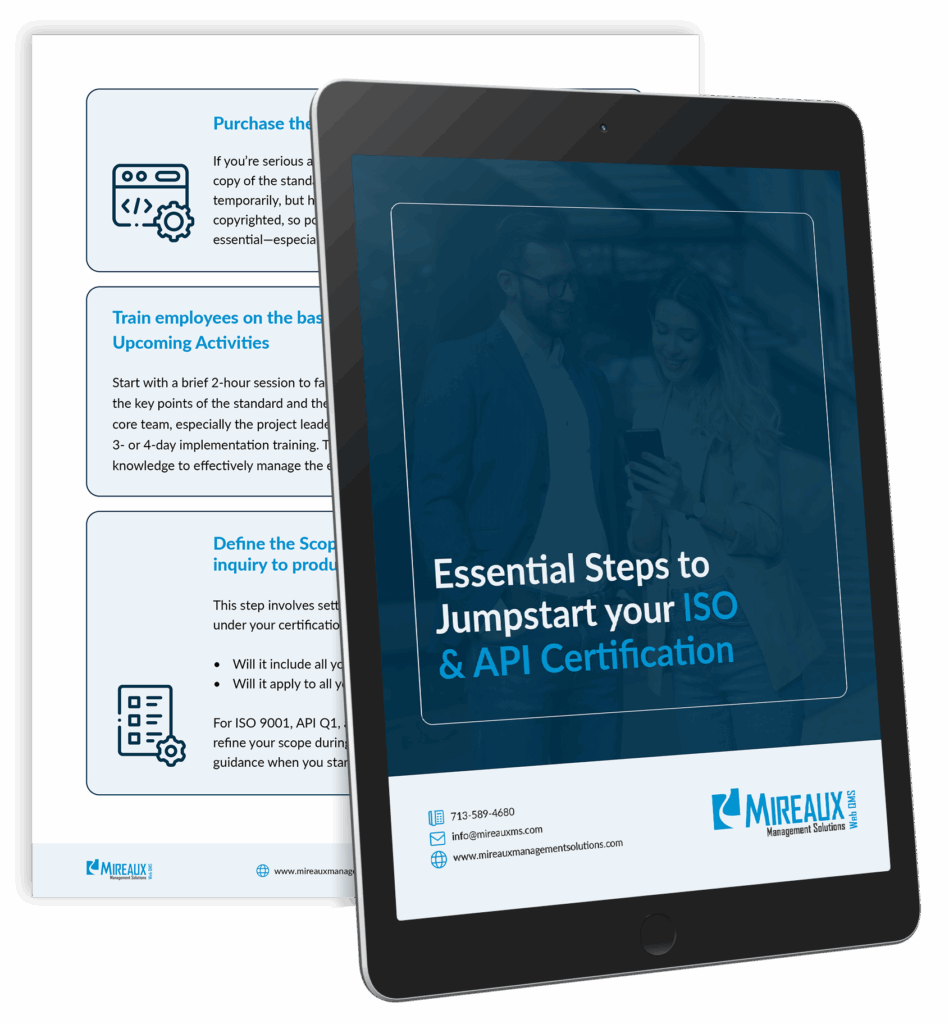

Free Essential Guide

The Essential Steps to Jumpstart your ISO/API Certification Journey!

These are the same steps our own Consultants use to successfully guide our clients to achieve ISO/API certification.